Why the state certifies markets and producers separately
California's certified farmers market program splits certification between two parties: the market and the producer. This distinction exists to protect the integrity of the "certified" claim for shoppers, and to create a clear chain of accountability for regulators. When a shopper buys certified produce, they trust it came from a real farm, not a reseller or distributor. The state's dual certification system sets up independent checks for both market operations and on-farm production.
A certified market must be approved as a venue that limits sales to agricultural producers from California. The market's manager becomes responsible for enforcing those restrictions on site. Meanwhile, each producer must prove they grow what they plan to sell, through a separate application and review process. This structure keeps the role of marketplace manager distinct from that of the farming business, and clarifies who is responsible for each piece of compliance.
If a market lets in an uncertified vendor, or if a producer tries to sell products they did not grow, the state can investigate and take action against the appropriate party. This approach means the market's certification does not automatically cover every booth: each stall is accountable for its own paperwork.
Keep reading: What a Stall Fee Has to Cover: Market Budget Math by Day
The Certified Producer Certificate and what it lists
The backbone of producer verification in California is the Certified Producer Certificate, or CPC. This is an official document issued by the county agricultural commissioner after reviewing a farmer's application and inspecting their operation. The CPC spells out exactly what the producer grows, on what land, and in what volumes. It lists the crops, varieties, and acreage or number of trees, along with the farm's physical address and contact details.
This certificate is not a generic license. It is tailored to each farm and is updated seasonally or when the producer adds new crops. If a farmer grows stone fruit, greens, and eggs, each of these items will be specified on the CPC. The document must be available for review at every market where the producer sells, and market managers often check it at load-in. If a product is not on the CPC, it cannot be sold as "certified" at a certified market.
For producers with multiple parcels or collaborative operations, each farm site may require its own certificate. The system does not allow for a blanket approval covering unrelated producers. Certificates are valid for up to twelve months and must be renewed regularly. This paperwork trail allows for traceability if a dispute arises over the origin of goods.
Registering the market with the county agricultural commissioner
Every certified farmers market in California must register with the county agricultural commissioner where the market is physically located. The registration process involves submitting a detailed application that covers location, hours, market manager information, and the intended list of participating producers. The commissioner's office reviews the application to ensure the market's rules and layout comply with state guidelines.
The county commissioner also becomes the main regulatory contact for the market, conducting regular inspections and responding to complaints. Registration is not permanent: markets must renew their approval annually, and any significant changes such as relocation, extended hours, or a change in management must be reported promptly. Failure to maintain up-to-date registration can lead to suspension or loss of certified status.
Some counties require markets to hold a preparatory meeting with county staff each season. This is a chance to clarify local rules, review past compliance issues, and review stall assignments or vendor lists. A registered market receives a certificate of operation, which must be posted at the entrance during open hours. This certificate signals to shoppers and regulators alike that the market is monitored under state law.
Keep reading: A Farm Visit, Start to Finish: How Markets Verify Growers
Load lists, harvest records and an inspection on market day
Once the market and producers are certified, managing day-to-day compliance falls to the market manager. The state requires every certified producer to keep harvest records and load lists. A load list details all products brought to market that day: quantity, type, and source. This document should match the CPC and be available for inspection from set-up through breakdown.
Harvest records are less public but equally important. They serve as a log of when and how much of each crop was picked. If a county inspector visits the market, they may audit these records to verify that the volume of goods being sold aligns with what was actually harvested. A mismatch can trigger further investigation, and if the paperwork is missing or incomplete, the producer may face penalties or be barred from selling.
Market day inspections
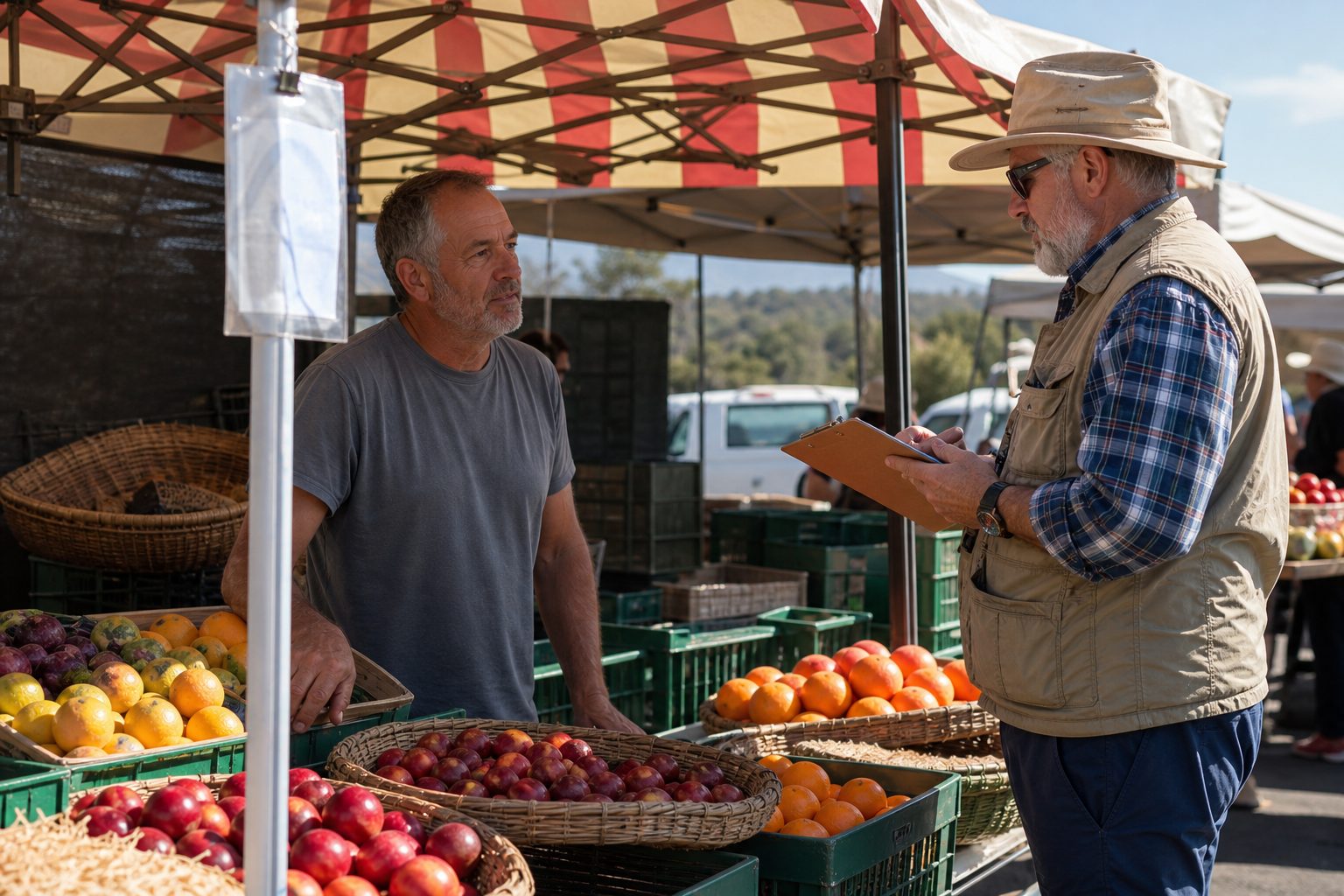
County inspectors conduct unannounced visits to check compliance. They may ask to see a producer's CPC, review the load list, and compare products on display to the paperwork. Inspectors also observe market operations: Are non-certified vendors separated from certified producers? Are signs posted correctly? These visits are typically brief but thorough. The goal is to catch problems before they become patterns.
For market managers, the best prevention is a routine check-in each market day. Reviewing vendor paperwork at set-up, confirming stall assignments, and encouraging vendors to keep records current all reduce headaches if an inspector arrives.
The state stamp fee and the enforcement it funds
Every certified producer pays a fee based on their participation in certified farmers markets. This is known as the state stamp fee. The fee is calculated per market location and is collected by the county agricultural commissioner at the time of CPC renewal. The revenue funds state and county inspection programs, pays for enforcement staff, and supports outreach to markets and producers.
The fee structure creates an incentive for producers to participate only in markets where they are actually selling, and for market managers to keep accurate records of vendor participation. Counties may audit attendance records and compare them to fee payments. If a producer is listed at more markets than the fee covers, the commissioner may investigate. This system underpins the funding for surprise inspections, complaint investigations, and staff training.
Some markets find the fee process complex because each county may interpret the rules differently. However, the core principle is consistent: the fee supports enforcement and oversight, not just paperwork for its own sake. Managers who understand the fee system are better prepared for audits and can ensure their vendors stay current with payments.
See how StallDeck handles this for farmers markets
Second certified producers, agents and who may sell for whom
California allows some flexibility for farmers who need help selling their products. Under state rules, a certified producer may sell for another certified producer at a market, but there are strict limits. The producer acting as an agent must have both their own CPC and a copy of the other producer's CPC, along with a completed agent authorization form. All paperwork must be available at the stall, and both producers must be listed as participating vendors with the market manager and the county.
The system is designed to help small farms pool resources without diluting the certified claim. However, a single producer can only represent a limited number of other producers: the standard rule is selling for no more than two other certified producers at the same market. This keeps the system manageable and prevents third-party resellers from entering through the back door.
Only the crops listed on each producer's CPC may be sold by the agent. If an inspector finds products at the stall that are not covered by the paperwork, both parties can face sanctions. Additionally, the original producer must be named in all signage and receipts, so shoppers know exactly where the food comes from.
Family members and employees can sell on behalf of the certified producer, but they must be directly employed and not working for multiple unrelated farms. The paperwork must clearly show the relationship and the coverage for each staff member. Market managers often check agent forms at the start of each season and keep copies on file for quick reference.
What non certified vendors may sell in the same aisle
Not every stall at a California certified farmers market sells certified products. The law allows for non-certified vendors, but their location and product range are regulated. Non-certified vendors may offer items such as baked goods, jams, honey from non-certified sources, crafts, or prepared foods. However, these products must be kept separate from certified agricultural goods. Typically, certified producers are grouped together in a designated area, with non-certified vendors in a separate section or aisle.
The market layout is not just for aesthetics. State inspectors use it as a quick check that the market is not misrepresenting non-certified products as certified. Signs must clearly mark where certified goods are sold, and non-certified vendors cannot display the certified market logo or use marketing that implies state verification. Managers enforce this separation by assigning stalls, reviewing vendor applications, and posting clear signage.
Some markets use a color-coded system for stalls or require vendors to display their business cards and product lists. The key requirement is transparency for shoppers: they should be able to tell at a glance whether a product is covered by the certified system. Managers who maintain strict separation make inspections smoother and build trust with customers.
What managers in other states borrow from this model
California's certified farmers market rules are among the most detailed in the country, but their core concepts have influenced market management far beyond state lines. Markets in other states may not require separate certification for producers and markets, but many have adopted some form of producer verification, periodic inspections, and market registration with local authorities. The goal is similar: maintain the credibility of "direct-from-the-farm" claims and create a transparent, accountable system for shoppers and regulators.
Some states use a self-attestation system, where producers swear to grow what they sell, but require regular spot checks by market managers or extension staff. Others have developed their own versions of the CPC, tailored to local crops and farm structures. Many managers have found value in keeping detailed vendor lists, enforcing stall separation, and requiring on-site paperwork, even if not mandated by law. These practices make it easier to resolve disputes, respond to complaints, and foster a fair marketplace.
Increasingly, managers are turning to digital tools to track stall assignments, vendor paperwork, attendance, and public listings. Platforms that combine these features make it easier to maintain compliance, simplify audits, and communicate with both vendors and shoppers. Tools like StallDeck support managers in meeting the regulatory demands described above, while freeing up time for relationship building and market growth.